


In Manhattan’s prime residential market, the number of properties available for sale often bears little resemblance to the number a particular buyer would seriously consider.
Inventory is one of the most frequently cited measures of the residential real estate market. We count available properties, compare them with previous periods, and draw conclusions about supply, demand, and negotiating leverage. Yet these figures can obscure an important distinction: the number of properties for sale is not necessarily the number a buyer would seriously consider purchasing.
Two residences may share the same neighborhood, price, bedroom count, and square footage, yet offer fundamentally different propositions. One may possess architectural qualities that are nearly impossible to reproduce. Another may offer better proportions, greater privacy, or a more functional layout.
Both count equally toward reported inventory. They are not necessarily interchangeable.
This distinction becomes particularly relevant in Manhattan’s prime residential market, where buyers frequently seek combinations of characteristics that conventional listing statistics cannot adequately capture.
What Five Manhattan Property Searches Reveal
To examine how available inventory translates into meaningful choice, I reviewed five actual buyer searches. Each involved specific requirements concerning location, property type, size, architecture, or condition.
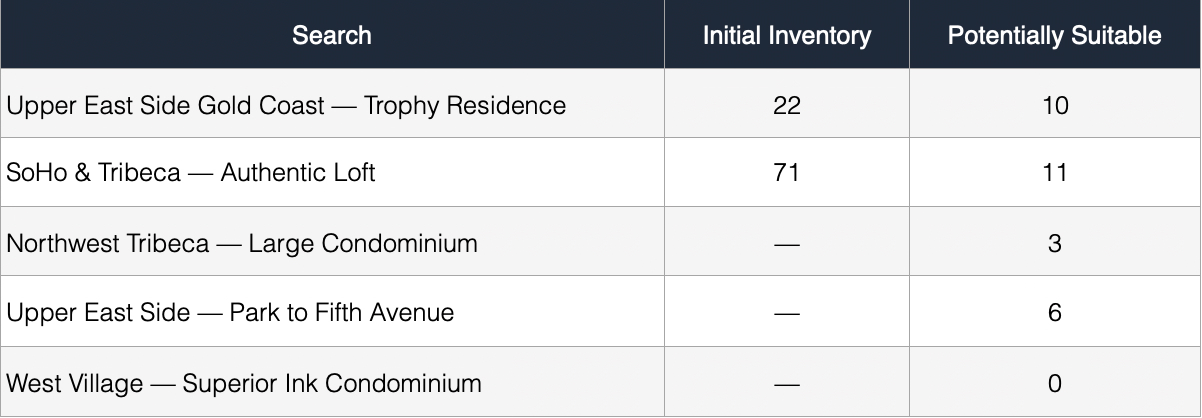
Consider a search for a trophy residence on the Upper East Side Gold Coast (East 62nd street to East 88th Street and from Fifth Avenue to Park Avenue), with a budget of up to $45 million. An initial review identified 22 properties, including co-ops and townhouses. Thirteen appeared to possess potential trophy characteristics, but only 10 warranted further consideration through an in-person inspection.
One townhouse represented a rare surviving example of an earlier architectural era. Its historical significance and difficulty of replacement were undeniable, yet its configuration raised questions about its suitability as a contemporary private residence.
Another property, a prestigious Fifth Avenue co-op, had undergone extensive renovations tailored to its owner’s preferences. Despite the investment, prolonged market exposure suggested a possible disconnect between the asking price and prospective buyers’ perception of value.
Rarity does not necessarily create desirability, and substantial expenditure does not automatically translate into market value.
A similar distinction emerged in a search for an authentic loft in SoHo or Tribeca. The buyer sought exposed structural elements, generous ceiling heights, expansive living spaces, and genuine architectural character.
Of 71 initially identified properties, only 11 appeared to satisfy those requirements.
Other searches revealed scarcity before qualitative evaluation even began. In northwest Tribeca, a buyer seeking a condominium with at least four bedrooms, four bathrooms, and 3,000 square feet had only three publicly available options. On the Upper East Side, a $20 million budget produced six potential residences meeting a specific combination of location, size, and configuration.
In the most restrictive example, a buyer seeking a three- or four-bedroom residence in one particular West Village condominium building had no publicly available options.
These findings do not establish a general shortage of Manhattan residential inventory. They illustrate how dramatically available choices can narrow when measured against individual requirements.
The Three Dimensions of Residential Scarcity
These searches reveal three forms of scarcity that conventional inventory figures can overlook.
Geographic scarcity arises when location restricts the available selection. A buyer seeking a residence within a few specific blocks—or a particular building—may find that properties elsewhere in the neighborhood are not meaningful alternatives.
Functional scarcity emerges when several requirements must be satisfied simultaneously. Four bedrooms, generous square footage, an efficient layout, and a particular configuration may each be relatively attainable individually, yet difficult to find together.
Qualitative scarcity concerns characteristics that are harder to measure: architectural significance, authenticity, proportions, craftsmanship, and replacement difficulty. A residence may satisfy every conventional search criterion while lacking the qualities that make it genuinely desirable.
These dimensions often overlap. Finding another property that reproduces a particular combination of location, functionality, and architectural distinction may prove exceptionally difficult.
There is, however, an important distinction between genuine market scarcity and scarcity created by individual preferences. A narrowly defined search will naturally produce fewer alternatives. That does not necessarily indicate a broader shortage of housing.
What This Means for Buyers and Sellers
For buyers, the challenge is distinguishing essential requirements from preferences worth reconsidering. Location, architectural integrity, natural light, and certain structural characteristics may be difficult or impossible to change. Interior finishes and cosmetic details generally offer greater flexibility.
The objective is not simply to expand the selection, but to understand which compromises preserve long-term value.
For sellers, the relevant competition is not necessarily every property within the same neighborhood or price range. It consists of residences that appeal to buyers seeking similar characteristics.
A property possessing a genuinely difficult-to-replace combination of qualities may face limited direct competition. Yet scarcity alone does not justify a premium. Those qualities must also be valued by the buyers most likely to consider the property.
When Scarcity Does Not Justify a Purchase
Limited choice can exert its own pressure. When only a handful of properties qualify, buyers may become more willing to overlook weaknesses or pay a premium simply because alternatives are scarce.
Yet rarity and value are not the same thing. The more important question is whether the characteristics that make a residence difficult to replace also make it worth owning.
An inventory search may yield ten credible candidates, three, or none. The most important outcome is not how many properties remain, but whether any of them deserves to be purchased.